
What is asthma?
Asthma is a common, long-term condition where the airways are very sensitive to anything that
irritates them, making it harder to breathe.
Common symptoms
 Wheezing
 Tightness in the chest
 Shortness of breath
 Cough
Cough
Common triggers
 Airborne irritants (like smoke and fumes)
 Allergens (like pollen, dust and mould)
 Animals and pet allergies
 Cold Air
Triggers differ from person to person. There may be others, so please discuss with your doctor.
Asthma affects your airways in two ways.
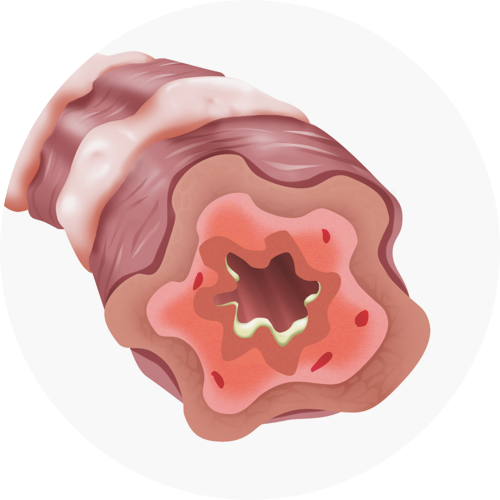
Airway Tightening
Symptoms you feel
The common symptoms of asthma are caused by the constricting of muscles around your airways making it hard to breathe.
Reliever Inhalers treat the symptoms you feel.
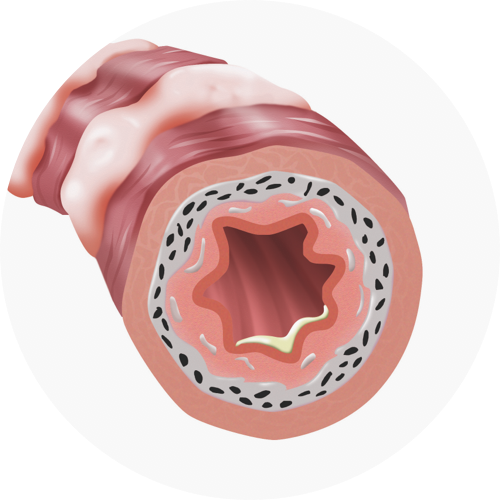
Swelling & Inflammation
Hidden cause
If you have asthma, your airways become swollen or inflamed. Though it can’t always be felt, this can make airways more sensitive to triggers, and cause symptoms.
Preventer Inhalers treat swelling & inflammation.

For effective asthma control, it’s important to treat both
For people with asthma, this means treating both the symptoms (airway tightening) and what causes them (the underlying inflammation).

Want to learn more about asthma?
Download our Quick Guide to asthma and Symbicort.
This visual snapshot is a guide to understanding asthma and how Symbicort can help. Share this with your doctor to discuss.
Symbicort® Prescription Medicine. For relief of and/or regular treatment of asthma. Symbicort® has risks and benefits. Budesonide/formoterol 100/6, 200/6. For product information check with your doctor or Consumer Medicine Information on www.medsafe.govt.nz www.medsafe.govt.nz. Click for further details. AstraZeneca (NZ) Ltd. Auckland.
Ready to learn more about Symbicort? Talk to your doctor today.
USEFUL LINKS:


This site is intended for New Zealand consumers only.
Keep using your asthma medication as prescribed by your doctor until they tell you to change. Your doctor may prescribe Symbicort Turbuhaler in a different way or for a different indication to that which is described here. Follow your doctors directions carefully. Usually you do not feel any side effects when you use Symbicort. The most common side effects of Symbicort are mild irritation in the throat, coughing, hoarseness, thrush (of mouth or throat), headache, tremor, palpitations and pneumonia (in COPD patients). Tell your doctor if any of these or other unusual effects bother you.
Symbicort® is a prescription medicine for the treatment of asthma and COPD. For asthma: Anti-inflammatory reliever therapy (Symbicort 200/6); Anti-inflammatory reliever plus maintenance therapy (Symbicort 100/6; 200/6), maintenance therapy (Symbicort 100/6, 200/6, 400/12). For COPD (Symbicort 200/6, 400/12). Symbicort® has risks and benefits. Ask your doctor if Symbicort® is right for you. Use strictly as directed. If symptoms persist see your doctor. Symbicort® is fully funded on the Pharmaceutical Schedule. Normal doctor’s charges and pharmacy fees apply. Ingredients: budesonide/formoterol 100mcg/6mcg, 200/mcg/6mcg, 400mcg/12mcg. For product details check the Consumer Medicine Information, CMI, at www.medsafe.govt.nz.
References: 1. SYMBICORT Turbuhaler Consumer Medicine Information. Available from https://www.medsafe.govt.nz/Consumers/cmi/s/SymbicortThaler.pdf. Last accessed June 2022. 2. SYMBICORT Turbuhaler Data Sheet NZ. 3. National Asthma Council (NAC). Australian Asthma Handbook V2.1. Guide to Reliever Medicines. 2020. Available at: https://www.asthmahandbook.org.au/resources/medicines-guide/relievers. Last accessed 09 September 2020. 4. Asthma and Respiratory Foundation NZ. What is Asthma? Available from https://www.asthmafoundation.org.nz/your-health/living-with-asthma. Last accessed on 9 December 2019. 5. Global Initiative for Asthma. Global Strategy for Asthma Management and Prevention, 2022. Available from https://ginasthma.org/wp-content/uploads/2022/05/GINA-Main-Report-2022-FINAL-22-05-03-WMS.pdf . Last accessed June 2022. 6. Asthma and Respiratory Foundation NZ: NZ Adolescent and Adult Asthma Guidelines 2020. Available from https://www.nzrespiratoryguidelines.co.nz/uploads/8/3/0/1/83014052/arfnz_adolescent_and_ad ult_asthma_guidelines_.pdf. Last accessed 24 July 2020. 7. Asthma and Respiratory Foundation NZ. Reliever Inhalers. Available from https://www.asthmafoundation.org.nz/your-health/living-with-asthma/asthma-medication/reliever-inhalers. Last accessed on 3 June 2019. 8. SYMBICORT Turbuhaler NZ Instructions for Use.
Symbicort®, Turbuhaler® and Bricanyl® are trademarks of the AstraZeneca Group of companies. Ventolin® is a registered trademark of the GSK group of companies. SalAir® is a registered trademark of Rex Medical. Respigen™ is a trademark of Mylan. Registered user AstraZeneca Limited, PO Box 87453, Meadowbank, Auckland 1742.
For Medical Information enquiries or to report an adverse event or product quality complaint: Telephone 0800 684 432 or (09) 306 5650 or via https://contactazmedical.astrazeneca.com.
September 2026, NZ-2634, TAPS DA2504JL, INDE14381.
Quiz code are